
Summer in Baden-Baden
trains, thermal baths, and para-fiction

I don’t remember how I first came across Summer in Baden-Baden but I’ve been staring at the second-hand copy that sits on my bedroom bookshelf ever since I moved apartment, believing (from the title and cover alone - oh how I should have known!) that it would be a whimsical read of sorts, ideally something with the stakes and wits of an Edith Wharton novel. I finally picked it up last week and had closer look only to find out, (1) this was not (strictly speaking) a Russian novel set the in 19th century’s most fashionable thermal resort, but a somewhat fictionalised retelling of Dostoevsky’s time at said fashionable spa, and (2) that the introduction to the edition was written by non other than Susan Sontag(!!!), which then led to a whole other type of outsized expectation.
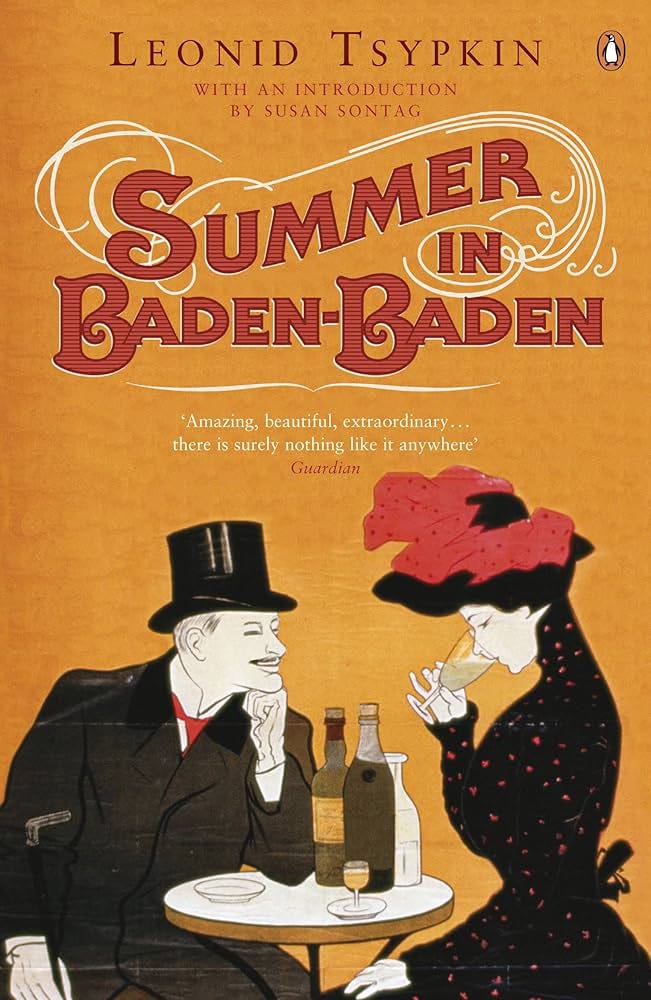
Written between the late 1970s and early 80s, Leonid Tsypkin, a doctor born to Russian-Jewish parents in 1926, sadly never lived to see his book published. In fact, Tsypkin passed away merely seven days after his son was able to place Summer in Baden-Baden in a Russian-émigré weekly in the United-States. Tsypkin and his wife had on a few occasion attempted to apply for exit-visas, though they never successfully left their country. Which precisely adds to what makes this work unique: Summer in Baden-Baden is a retelling motivated by the love of literature, the love of Dostoevsky, but it is largely an imaginary journey, as Tsypkin was never able to go beyond the Russian sites of Dostoevsky’s life.
Indeed, the premise of this book lies in the trip that the narrator (presumably Tsypkin himself) takes to the available sites of Dostoevsky’s life and novels, namely the ones in Russia. The story begins with the book Tsypkin reads on the train from Moscow to Leningrad. The book he reads, are the diaries of Fyodor Dostoevsky’s second wife, Anna Grigoryevna, which is made up of recollections of she and her husband leaving Saint Petersburg for Baden Baden in 1867.
Part-autobiography, part-historical fiction, Summer in Baden-Baden is a genre bending double narrative. Sontag refers to it as “para-fiction.” In it, Tsypkin layers his own train journey along that of the Dostoevskys. Though Sontag heavily praises the book in her introduction, I would say the work almost veers towards fan-fiction. Which isn’t necessarily bad, after all, I have also traveled in order to visit the homes of literary figures I admire, and hold the knowledge of my visit along side my own biographical situation at the time. I didn’t write a book about it, but surely a newsletter or two…
Sontag compares this work to J.M. Coetzee’s The Master of Petersburg, apparently also a Dostoevsky fantasy (I haven’t read it!). Although Sontag makes sure to state how Tsypkin wanted, above all, for all the factual elements in the book to be in line. The result is perhaps an honourable attempt at verisimilitude, a researched, well-intentioned exercise in day dreaming.
Sontag goes on to write,
The account of the Dostoyevskys’ travels - for they will be mostly abroad in Tsypkin’s novel, and not only in Baden-Baden - has been scrupulously researched. The passages where the narrator - Tsypkin - describes his own doings are wholly autobiographical. Since imagination and fact are easily contrasted, we tend to draw genre lessons from this, and segregate invented stories (fiction) from real-life narratives (chronicle and autobiography). That’s one convention - ours. In Japanese literature, the so-called ‘I-novel’ (shishosetsu), a narrative that is essentially autobiographical but contains invented episodes, is a dominant novel form.
As someone who studied literary theory, the genre implications of this work are certainly interesting but I kept wondering if that was enough for me. And in this context, I’m not such a stickler about facts, and I think I’d still rather read fiction. Stylistically, Tsypkin also does something annoying, I suppose because of the interweaving narrative business of it: not only are there no chapter breaks, the run-on sentences border on never-ending, and you’re lucky if there’s a chapter break per page. Again, I understand the desire effect of interweaving narratives, but it did not do it for me. This is where Sontag’s praise does the book a disservice, because reading it actually made me want to put this down and read Dostoevsky instead.
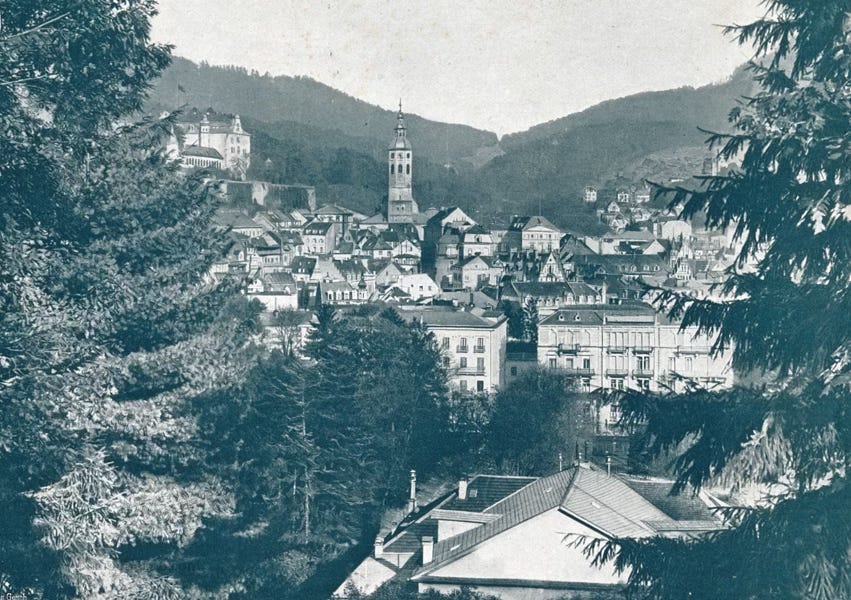
Funnily enough, Sontag calls this work “crash course on all the great themes of Russian literature,” which gets me to the part that initially drew me to this work. Again, I really went into this book thinking it was a work of fiction, and the title had tickled me, because there is actually nothing more Russian than visiting a thermal spa in Germany in the 19th century. (read hyperbolic). Baden-Baden was one of the oldest and most famous spa towns, where people came not only for the benefits of mineral springs, but also to see and be seen, and to gamble. Dostoevsky was just one of many Russians who bathed and gambled in Baden-Baden, but perhaps the most famous.
The history of resort economies is rather fascinating, and their boom is but of course tied up with gambling, but also railroad travel! Trains made journeys to these resorts more accessible, and as such these resorts began expanding and accommodating more people (to the great dismay of aristocrats now having to rub elbows with people on trains!). What’s more, the growing restrictions on gambling in Europe (notably in France around 1837) simply made people flock to other places in Europe such as Germany, Austria, the town of Spa in Belgium (which gives its name to the activity!), Monaco, and so on! And the reason why it is so Russian, is because Russian aristocrats fled to these spas to escape their frigid winter. [A little side note to wrap this tiny history up with a bow: because of this, Monaco and the French Riviera was largely considered a winter destination, it is only in the first half of the 20th century that Americans began coming in the summer (rather off-peak!), and made it a summer destination. I am specifically thinking, once again about the Murphys.]
Dostoevsky remains one of the most famous gamblers and that fact is something of a main thread in the book. In fact, Dostoevsky’s novella The Gambler was written precisely because he had amassed such huge debts which he was so desperate to cover that he took an advance from his publisher that would force him to produce a book within a few weeks of the contract being signed. In turn, The Gambler is set in a spa town in Germany and centres an eccentric Russian!
In Summer in Baden-Baden, you get glimpses into Fedya and Anna’s relationship, and while individually their portraits are complex and convincing, together, descriptions of their relationship struck me as idealistic or melodramatic (not that Anna had it easy…). As for ‘plot,’ Fedya gambles all day, while Anna wanders around all alone. Fedya loses everything at the roulette table, begs his wife for her last coin, then proceeds to sell her engagement ring, and then her clothing, to cover his debts.
More interestingly, the story situates Dostoevsky by what he was writing and the manuscripts he was handing in. However, Dostoevsky doesn’t come across very well, rather bigoted and reckless. In fact, another layer of this work ought to be acknowledged, that of Tsypkin being Jewish, trying to wrestle with Dostoevsky’s rampant anti-semitism, though, as you would expect, there isn’t a clear solution to reconciling it.
Dan Jacobson writes in LRB, in response to what he considers Sontag’s “sweeping assertion that,”
‘loving Dostoevsky means loving literature’ – as if ‘love’ and ‘literature’ might jointly serve as a quasi-sacramental agency capable of lifting readers (Jewish or gentile) out of the predicament into which a writer like Dostoevsky hurls them. It would be more plausible to say directly that to love Dostoevsky is to hate him too; and that such an impossible concatenation of feeling is an appropriately Dostoevskian response to the man and his work. He is hateful because of the malignity of his xenophobia (of which his anti-semitism is the most toxic instance); because of his hysterically reactionary views; because of the combination of perfunctoriness and verbosity which marks so much of his work; because of his prurient fixations on ‘fallen’ women; even, for that matter, because of the visions of Christ-like forgiveness, reconciliation and redemptive suffering he can sometimes be seen labouring too hard to produce. Yet there it is: in all this, out of it, through it, there emerges a host of piercingly dramatic scenes, insights that turn compellingly from individual motivation to shifts in historical consciousness, passages of unsurpassed pathos and (not least, and too often forgotten where Dostoevsky is concerned) hilarious comedy – grotesque, deadpan, slapstick or kindly, as the mood takes him.
I would be inclined to agree with the love/hate sentiment Jacobson describes, though this is a hell of an undertaking from Tsypkin’s perspective, and I did not get the impression that Tsypkin was evaluating Dostoevsky and his views so much from a critical perspective (if only because of the fantasia-like quality of the work and the overflowing prose). Rather, Dostoevsky’s anti-semitism perhaps appears as something Tsypkin could not ignore, and in the narrative set up, that of reading on the train, it comes up, jumps out at him from the page and forces him to consider the writer he so admires against his own identity.
In the end, the premise of this book seems to rest on the author’s love for Dostoevsky’s literature as opposed to the person he was. And yet, if that is true, I still wonder what exactly motivated a retelling of this moment in Dostoevsky’s life when we can just read Dostoevsky (The Gambler?). I for one, have not read The Gambler, and the joke is on me, I guess, because I read the retelling. I’m not convinced Summer in Baden-Baden is an essential read, but perhaps I would have liked it more if I hadn’t gotten so excited about the charming title and Susan Sontag’s stellar introduction. Now that I have merely whelmed you, dear reader, I suppose you can safely go read this, expectations managed and all.
Alexandra! This is wonderful. So much so that I put the book high on my list of summer reads. We know Baden-Baden well. And this makes the book all the more appealing!
Dostoevsky fan fiction definitely should be a category.