
Yesteryear
the tradwife novel everyone is talking about!

This week I wanted to discuss Yesteryear by Caro Claire Burke, a book I’ve been excited to read for a while now! It was a highly anticipated release because of its provocative (and hell of a timely) premise: A tradwife and mother of six living on a farm with a big Instagram following, until one morning she wakes up to find herself living in the brutal pioneer realities of 1855. That is, without the perks of modernity, heating, good food, and her staff! A be-careful-what-you-wish-for premise, exposing the hypocrisy of the life she pretends to live online and had been selling to her followers. I don’t usually gravitate towards novels that capture a time-sensitive aspect of our culture (Transcription is the closest thing to a pandemic novel I picked up, but I also did not know it was a pandemic novel). But the tradwife discourse is seemingly not going anywhere, and this just the first tradwife novel among others set to come out in the next year. Though Yesteryear is certainly the one that has made the most noise (film rights were acquired before the book was completed and will be starring Anne Hathaway). Mostly, I am curious to see if decades from now these novels will be resources to understand this very weird moment in time.
Before I warn you off for spoilers (there is a twist I’ll be discussing below and I’m not entirely convinced by it), I’ll begin by saying this was page-turner!! I really enjoyed reading it, and would recommend anyone take this on vacation this summer and pass it around to friends to discuss. It is original, provocative, and there are a lot of great comedic moments.
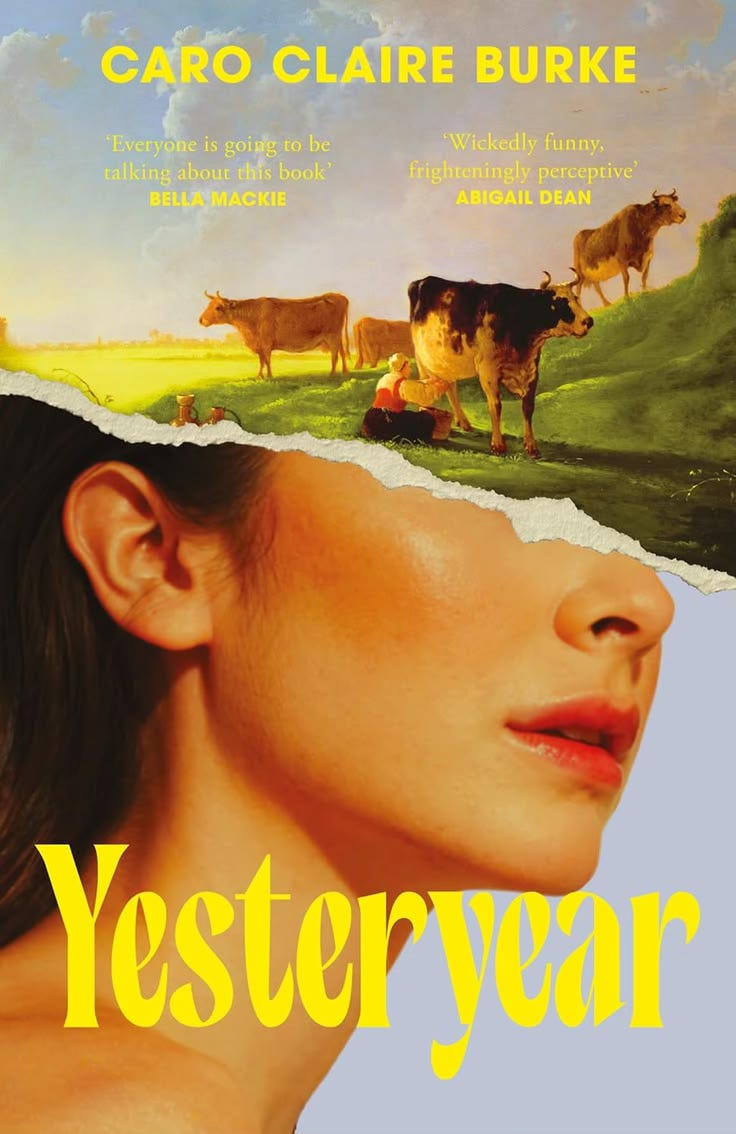
The novel is told from the perspective of our anti-hero, Natalie Heller Mills. Natalie is a character with truly terrible thoughts, six kids, and no penchant whatsoever for motherhood. She is strong-willed and knows what kind of a life she wants, and in light of her useless husband, knows she will have to go out there and make it happen for herself. I was hooked, and it took no time for me to start rooting for her and her fraudulent pesticide-filled ranch!!!!! Still, with such an ambitious premise, I’m not sure if the ending delivered its promises, or reached its full potential, which is what I’ll be discussing below.
Structurally, the narrative goes back and forth between Natalie’s life, beginning as a Harvard freshmen, and then swings back and forth to the 1855 pioneer world she seemingly has been transported to, until both narrative collapse into some sort of explanation.
Already in college, Natalie may keep to herself, but she knows what kind of femininity she disapproves of, and is sick of being “waterboarded with modernity.” She begins a rivalry with her progressive roommate Reeva, which she will continue to nurture like an obsession long out of college. It is also in college that she meets her future husband, Caleb. In fact, it doesn’t take too long for him to become her husband. They marry while still in college (I think during freshmen year?), and Natalie drops out shortly thereafter, once she’s pregnant with her first child. It also doesn’t take her long to realise that Caleb is an idiot and completely unambitious. But Caleb comes from money and his father is a famous politician, who is looking to run for President (this is one of my favorite plotlines). Caleb has no ambitions or desire to work, the only thing that gets him excited is the idea of living on a farm, and living off its produce, as he increasingly starts consulting conspiracy theory forums in the MAHA & manosphere realm. And so, influencing arises out the need for Natalie to take matters into her own hands.
And as it happens, Natalie quickly becomes an online symbol of the ideal housewife on manosphere blogs that Caleb consults, and on the other end of the spectrum, rage-bait for progressive women, AKA, the Angry Women. You keep reading as tension builds up, the hypocrisy of Natalie’s life against a carefully curated pastoral projection of what a real American family should be. In the background: modern kitchen appliances, nannies, and an in-house producer helping her film her content. Supposed organic vegetable are being grown in the garden by her cowboy/MAHA-pilled husband, but he fails to properly grow these vegetables, so Natalie has them secretly sprayed with pesticides by the immigrant workers, and it is her Brooklynite in-house producer (whom Natalie has always been suspicious of) who begins asking questions and poking her nose around (which is all I’ll say).
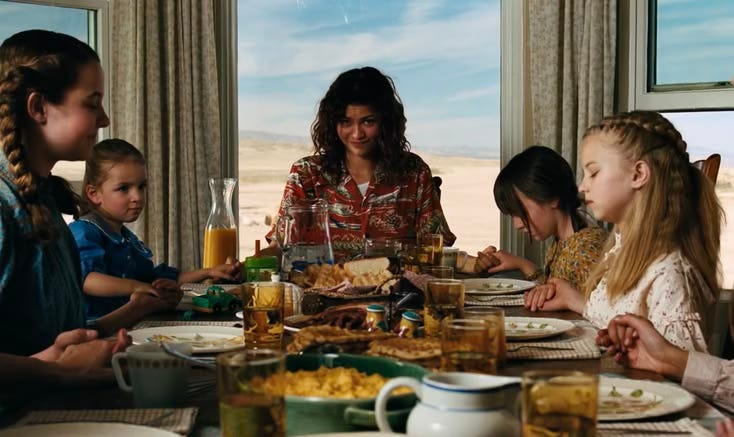
Ironically, it is Natalie’s husband Caleb, who wishes he could play with the kids all day and not work. While Natalie barely looks at her children and runs the entire operation at home through which the family lives.
He was good at playing with babies. He never grew bored or irritated with Clementine. He found her endlessly entertaining. In fact, that was the problem, wasn’t it? He had no desire to do anything else. My husband wanted too little from his life. And me? I wanted too much. Suddenly it was so obvious: Caleb should’ve been born a woman, and I should have been born a man. A sad sickness turned in my stomach. We were equally broken in that way.
Now, about the twist: In the 1855 version of the world, Natalie is forced to live the traditional lifestyle she was previously only staging for her online presence, and those parts of the text have the virtue of being short chapters, but they’re also strange and I wasn’t sure where we were being led. Still, what I thought would happen is that the ending would relate to some sort of political situation Natalie would find herself in the middle of, with her father-in-law becoming President or something of the sort, and she being instrumental in serving a political message through her lifestyle.
We learn in the last few pages that Natalie has not actually gone back to 1855. Instead, she suffered a mental breakdown when her public life has unravelled into scandal after her producer goes on television to give a tell-all interview about her experience working for Natalie. What had appeared to be a return in time, was actually the collapsing of Natalie’s sanity.
This twist has significant implications when it comes to the ultimate meaning of the novel: Natalie’s breakdown does not further the systemic critique of women living in a patriarchal society, complicity and what it means to benefit from a system that actually traps you.
What the twist does, is leave us with Natalie’s battle with mental health, which ends tragically by the way. The novel ends up saying something about women crumbling under pressure, chipping away at the satire that had been previously building up so strongly, lessening its critique of gender roles, the regressive ideals that sustained Natalie’s seemingly perfect lifestyle, religion, power, hypocrisy, influencer capitalism, in favour of making this a narrative about a woman having a mental breakdown. Don’t get me wrong, a woman having a breakdown is the premise of some of my favorite books of all time, though I’m not sure it serves the hugeness of Yesteryear’s ambitions.
Of course, Natalie is collateral damage to the cultural norms she helped shaped and propagate (while the men relatively remain unscathed, this could also a point of discussion), but this precisely is an interesting point of tension. The emphasis placed on her breakdown makes her seem as though she played less of a role in the system and was a victim of it, which I think is, for one, less interesting, but also maybe not the entire truth, considering what we know about Natalie. An alternate ending relating to something larger than her psyche would have perhaps made for a deeper exploration of profit and complicity, because I maintain that she is not a clueless character. Even at the start, when Natalie doesn’t know what she’s getting into when marrying Caleb, she learns fast. Natalie is pulling a lot of the strings, is extremely self-aware and knows how to read a room! I wanted to believe that the MAHA/ purity / manosphere implications were more than just timely entertainment and would actually contribute something larger to the ending.
A part of me wished Natalie would have somehow gotten back at the men in her life, her husband and her father-in-law, tanked both their political careers and spread her empire of cookware or whatever, some sort of chilling Ripley-esque ending, where Natalie gets everything she wants. But even for the reader hoping for Natalie’s downfall, I don’t think this isn’t a satisfying ending either: Throughout the novel, Natalie’s nastiness is fun to read, and suddenly the twist does not make it fun anymore. She’s having a mental breakdown and actually abusing her children (as opposed to ignoring them!), which makes it such that by the end you can’t even rejoice in her downfall because the situation is sad and sort of jarring.

Ultimately, I found the ending might have been a bit rushed, which is also why I think it underdelivered in terms of what I think it was trying to achieve.
I still think Yesteryear is incredibly original and worth reading!!! It has also been so cool to see the reception of this book. Anytime a novel is huge, it’s good for publishing. Caro Claire Burke has also shared how she spent all of her twenties being rejected by publishers, working on two entire novels before selling this one, which is refreshing to hear, and makes me all the more thrilled for her and what she’ll write next.
Over the next few weeks I’m planning on reading Lázár by Nelio Biedermann, and Swing Time by Zadie Smith, in case anyone wants to read along!